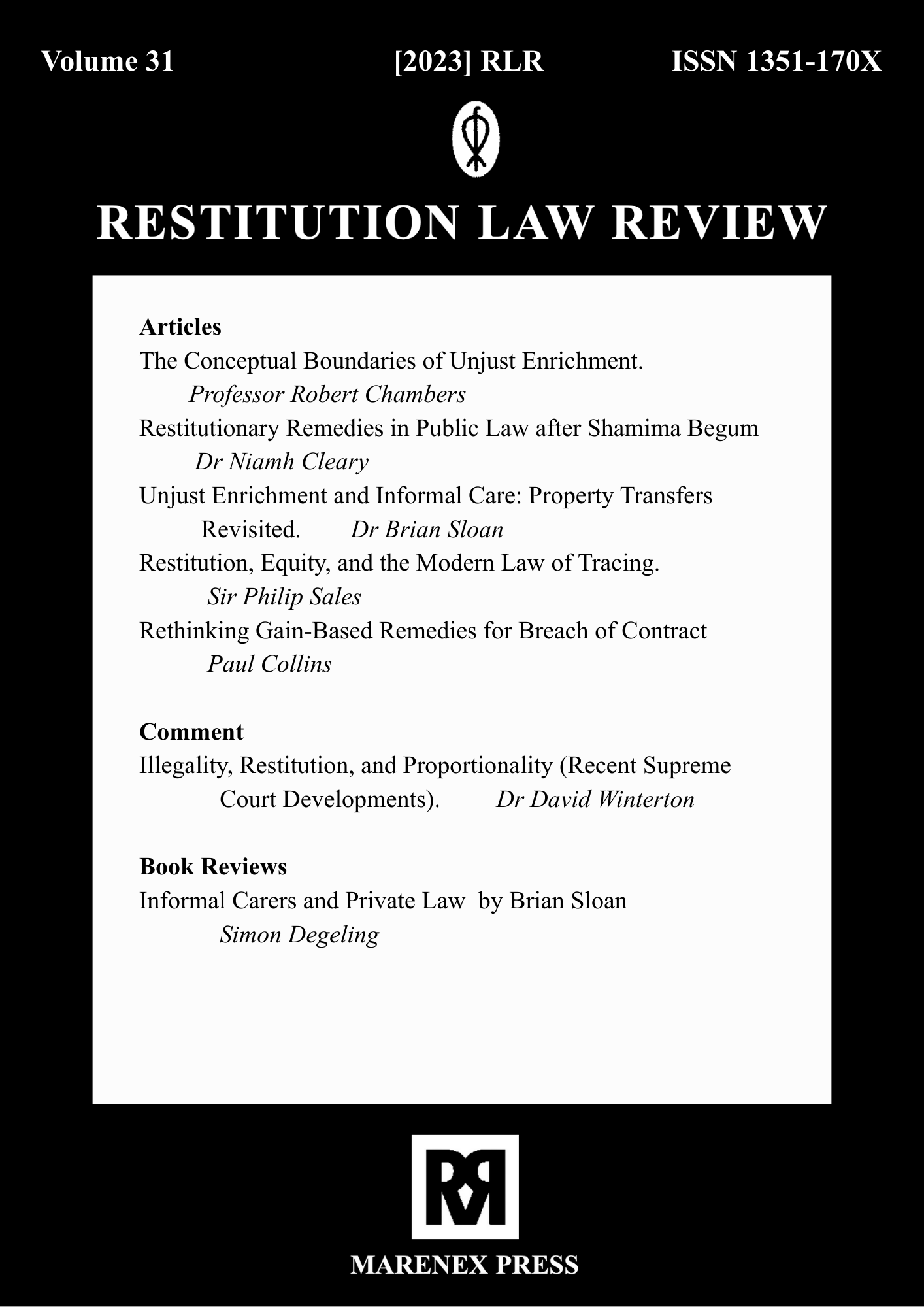
Rethinking Gain-Based Remedies for Breach of Contract
Abstract
Gain-based remedies for breach of contract occupy a contested position within private law, challenging traditional assumptions that contractual remedies should be purely compensatory. This article critically reassesses the theoretical and practical foundations of restitutionary and disgorgement remedies for breach of contract, with particular reference to the legacy of Attorney-General v Blake and subsequent case law. It examines the circumstances in which gain-based remedies have been recognised and evaluates whether their expansion can be justified on principled grounds. The article explores competing rationales, including deterrence, prevention of opportunistic breach, and protection of contractual interests, and assesses their compatibility with established contract law principles. It also considers the risk that gain-based remedies may undermine certainty and commercial predictability if applied too broadly. Through a close analysis of recent judicial trends and comparative perspectives, the article argues for a restrained and clearly defined role for gain-based remedies, limited to exceptional cases where compensatory damages are demonstrably inadequate. The article concludes by proposing criteria to guide courts in determining when such remedies are appropriate, thereby contributing to a more coherent and predictable framework for contractual restitution.
Published
Issue
Section
License
Copyright (c) 2023 Restitution Law Review

This work is licensed under a Creative Commons Attribution-NonCommercial 4.0 International License.