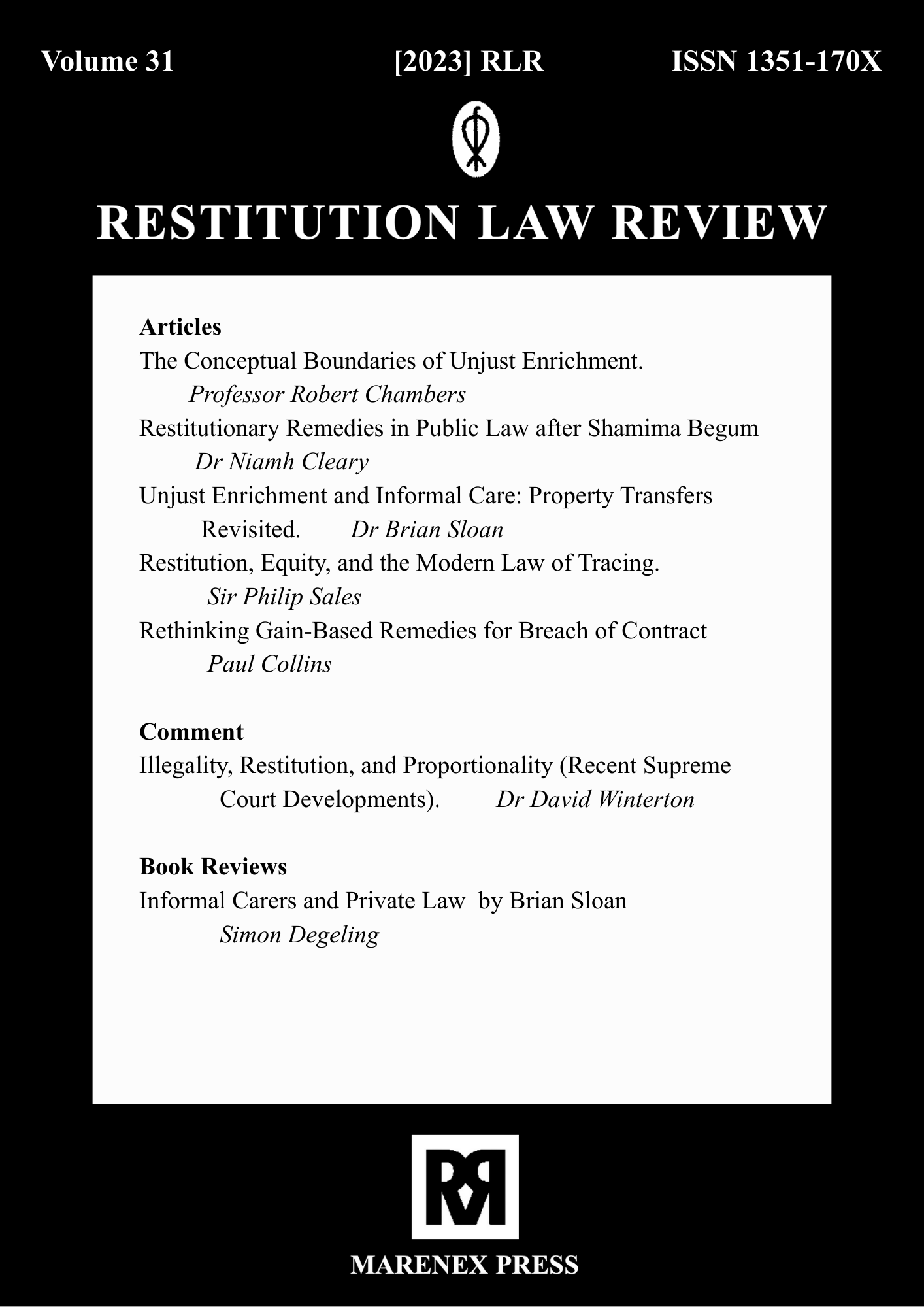
Illegality, Restitution, and Proportionality
(Recent Supreme Court Developments)
Abstract
This comment examines the evolving role of proportionality in restitutionary claims affected by illegality, with particular reference to recent Supreme Court decisions refining the approach articulated in Patel v Mirza. It analyses how courts have moved away from rigid rules of exclusion towards a more flexible, policy-sensitive framework that balances competing considerations of legality, deterrence, and fairness between the parties. The comment evaluates the extent to which proportionality has become a unifying principle in determining whether restitutionary relief should be granted, focusing on factors such as the seriousness of the illegality, the closeness of the connection between the unlawful conduct and the enrichment, and the impact of denying relief on the integrity of the legal system. By situating recent cases within the broader restitutionary landscape, the comment highlights both the strengths and the uncertainties of the modern approach, questioning whether proportionality offers sufficient predictability for litigants and lower courts. It concludes by suggesting that while flexibility is desirable, clearer doctrinal guidance is needed to ensure consistent application of illegality principles in restitution.
Published
Issue
Section
License
Copyright (c) 2023 Restitution Law Review

This work is licensed under a Creative Commons Attribution-NonCommercial 4.0 International License.