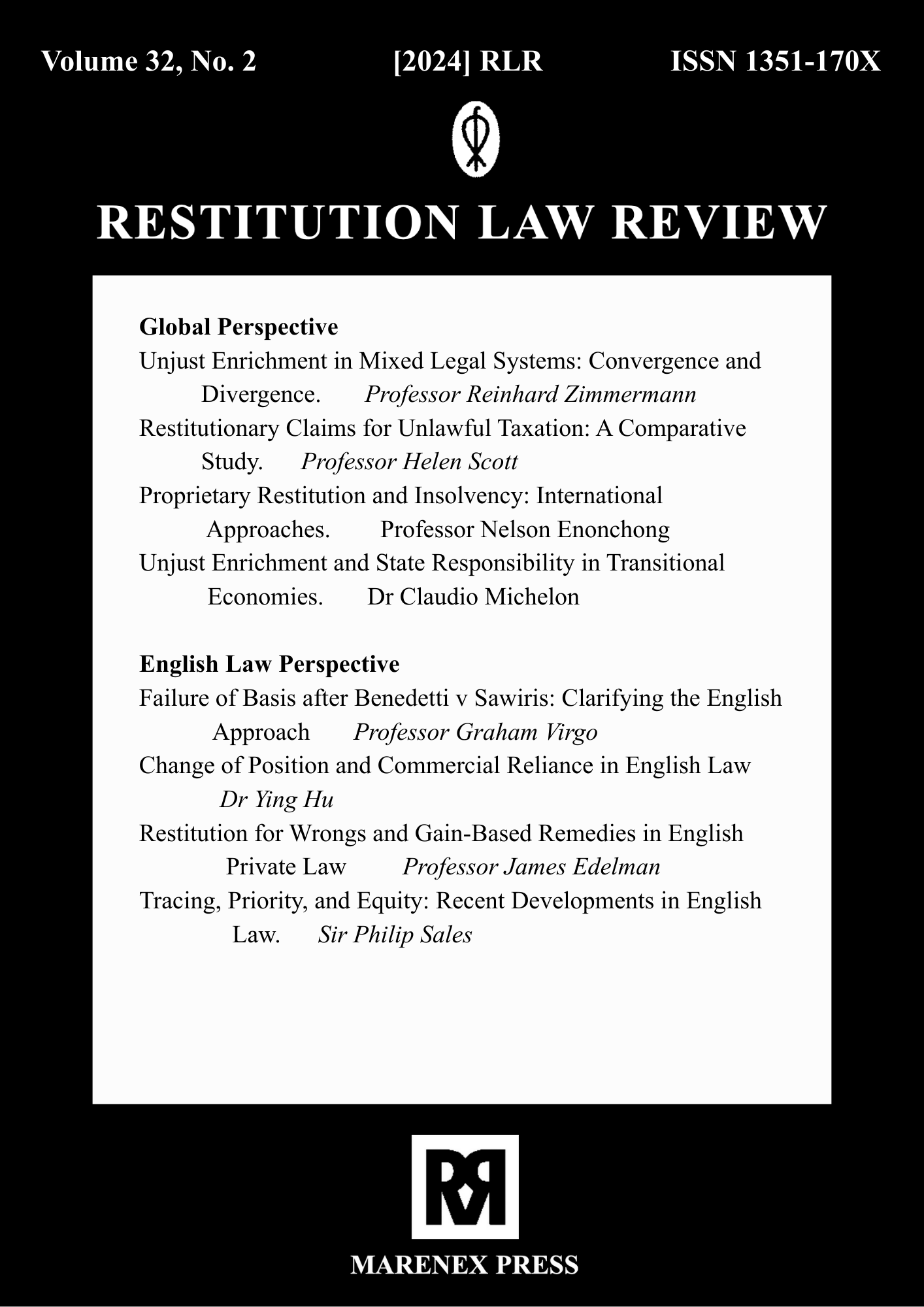
Unjust Enrichment in Mixed Legal Systems: Convergence and Divergence
Abstract
The law of unjust enrichment occupies a distinctive position within mixed legal systems, where common law and civilian traditions coexist and interact. This article examines how such systems have negotiated conceptual differences concerning unjustified enrichment, particularly in relation to the structure of claims, the role of juristic reasons, and the availability of defences. Drawing on comparative analysis from jurisdictions including Scotland, South Africa, and Quebec, the article explores the extent to which convergence has occurred in substantive outcomes despite enduring differences in legal taxonomy. It evaluates whether the increasing influence of comparative scholarship and transnational judicial dialogue has promoted coherence or merely masked deeper conceptual divergence. The article argues that mixed systems provide valuable insights into the strengths and limitations of both common law and civilian approaches, particularly in their treatment of enrichment arising from failed contracts and third-party transfers. By analysing recent judicial trends, the article contends that unjust enrichment can function as a unifying doctrine across legal traditions, provided that courts remain attentive to the normative foundations of restitution. The article concludes by suggesting that mixed systems may serve as laboratories for doctrinal innovation, offering lessons of broader relevance to global restitution law.
Published
Issue
Section
License
Copyright (c) 2025 Restitution Law Review

This work is licensed under a Creative Commons Attribution-NonCommercial 4.0 International License.