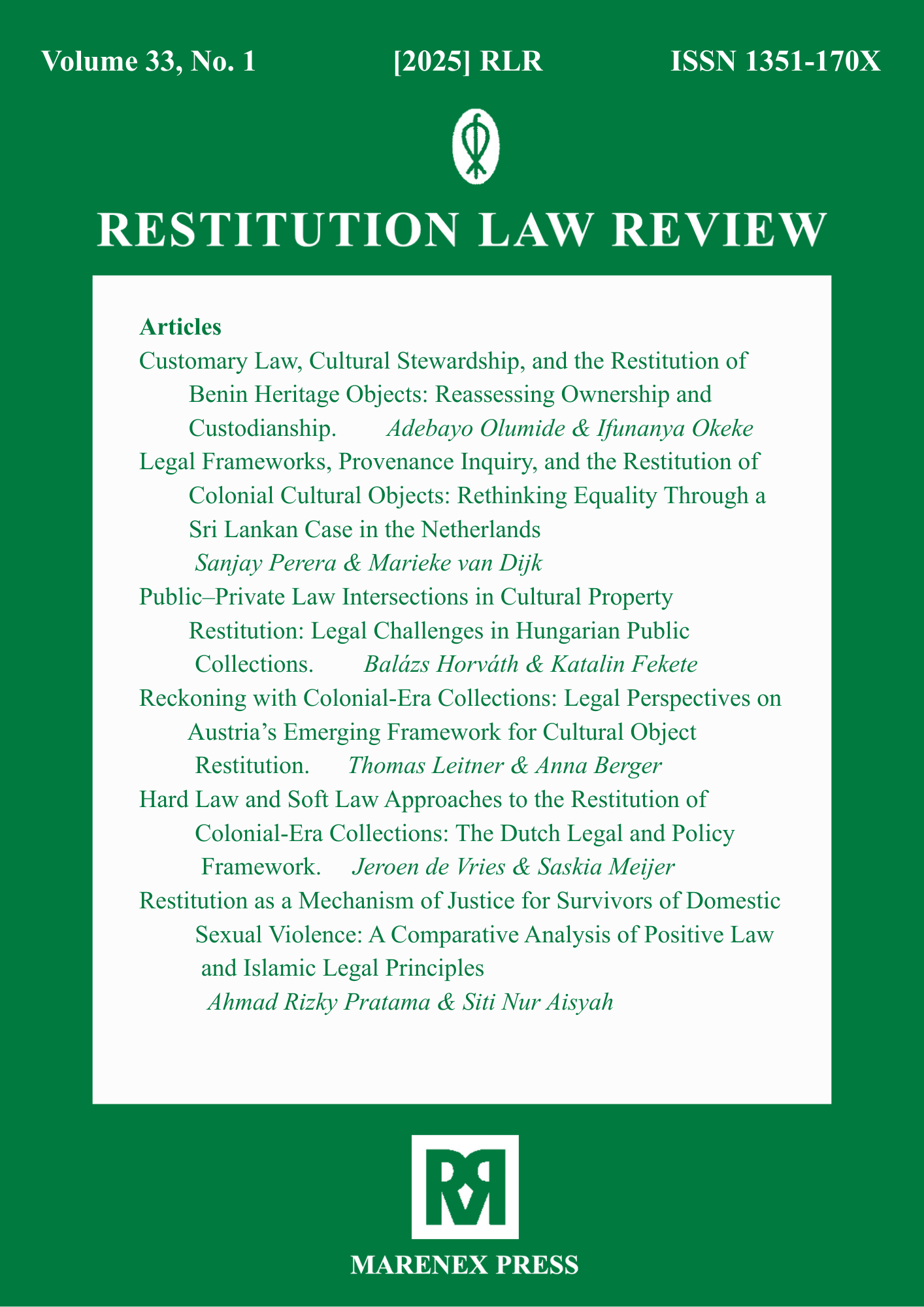
Restitution as a Mechanism of Justice for Survivors of Domestic Sexual Violence: A Comparative Analysis of Positive Law and Islamic Legal Principles
Keywords:
domestic sexual violence, restitution law, restorative justice, victim-centred justice, Islamic legal principles, criminal justice reformAbstract
Domestic sexual violence constitutes a serious yet often concealed form of gender-based harm, frequently underreported due to social stigma, power imbalances, and its treatment as a complaint-based offence in many legal systems. These conditions significantly impede effective law enforcement and limit victims’ access to justice, including timely restitution and adequate state protection. This article examines restitution as a criminal justice mechanism in cases of domestic sexual violence, assessing its effectiveness through the normative frameworks of positive law and Islamic law in the contemporary legal context. Employing a normative juridical methodology, the study analyses statutory provisions governing restitution and victim protection alongside relevant principles of Islamic jurisprudence. The article reviews the formal recognition of restitution within multiple legislative instruments, including laws on domestic violence, witness and victim protection, sexual violence offences, and recent criminal code reforms. Despite this formal recognition, the study identifies persistent limitations in the practical enforcement of restitution orders. Structural deficiencies, limited legal awareness, institutional constraints, and the economic incapacity of offenders frequently undermine the realization of restitution as a meaningful remedy for victims. From the perspective of Islamic law, the concept of compensation (taʿwīḍ) reflects a normative commitment to restoring victims’ rights and dignity. However, the article argues that traditional interpretations require contextual adaptation to align with contemporary legal systems and the realities of modern criminal justice. By integrating restorative justice principles, restitution can move beyond symbolic recognition toward becoming a substantive instrument of victim-centred justice. The article concludes by advocating for a strengthened restitution framework that prioritizes mandatory restitution over punitive fines, enhances institutional coordination, and addresses cultural and procedural barriers to enforcement. Such reforms are essential to developing a justice system that is responsive, equitable, and oriented toward the recovery, protection, and dignity of survivors of domestic sexual violence.
Downloads
Published
Issue
Section
License
Copyright (c) 2025 Restitution Law Review

This work is licensed under a Creative Commons Attribution-NonCommercial 4.0 International License.