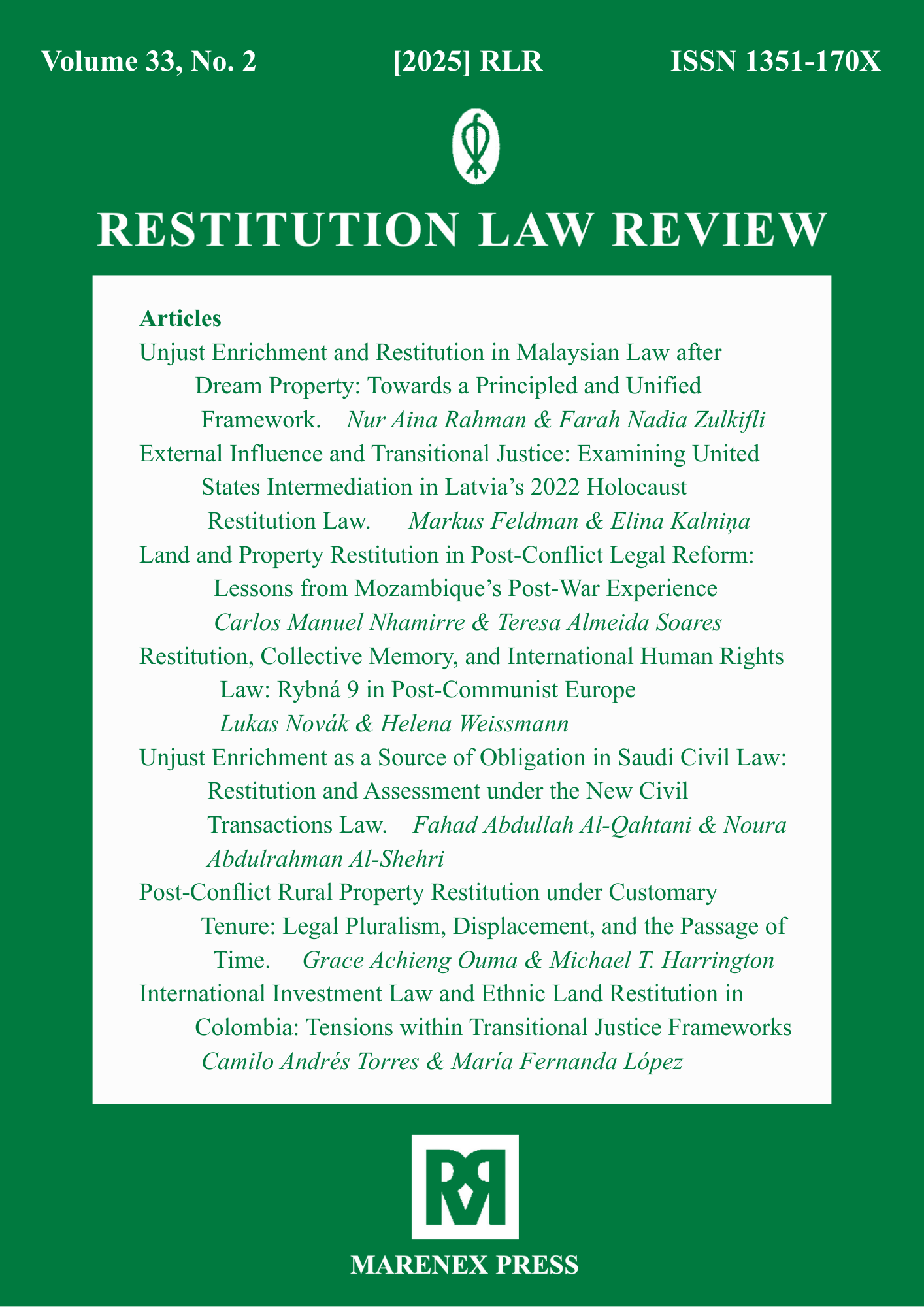
Unjust Enrichment and Restitution in Malaysian Law after Dream Property: Towards a Principled and Unified Framework
Keywords:
unjust enrichment, restitution, Malaysian contract law, law of obligations, comparative private lawAbstract
Part VI of the Malaysian Contracts Act 1950, dealing with “certain relations resembling those created by contract,” reflects the historical doctrine of quasi-contract, now commonly understood in common law jurisdictions as the law of restitution founded on unjust enrichment. The recognition of unjust enrichment as an independent cause of action by the Federal Court in Dream Property Sdn Bhd v Atlas Housing Sdn Bhd marked a significant turning point in Malaysian private law. Despite this development, the law of unjust enrichment in Malaysia remains at an early and formative stage, with important doctrinal and structural questions yet to be resolved. This article examines two central issues arising from the Dream Property decision. The first concerns the legal implications of the court’s apparent preference for the civil law–inspired “absence of basis” approach in determining unjust enrichment, rather than the traditional “unjust factor” approach that characterises English common law. The article critically assesses how this methodological choice may influence the coherence, predictability, and future evolution of unjust enrichment as a standalone cause of action in Malaysia. The second issue addresses the broader conceptual direction of unjust enrichment within the Malaysian legal system. The article evaluates whether unjust enrichment should develop under a dual framework, comprising both the statutory regime of the Contracts Act 1950 and parallel common law principles, or whether a more coherent and principled approach lies in using common law reasoning by analogy to inform and modernise the interpretation of Part VI of the Act. Employing doctrinal and comparative analysis, the article argues in favour of a unified framework that integrates unjust enrichment within the statutory scheme while drawing on common law principles to articulate its substantive content. It concludes that adopting the unjust factor approach within such a unified structure offers greater doctrinal clarity and practical utility, and provides a sound foundation for the principled development of Malaysian unjust enrichment law.
Downloads
Published
Issue
Section
License
Copyright (c) 2025 Restitution Law Review

This work is licensed under a Creative Commons Attribution-NonCommercial 4.0 International License.