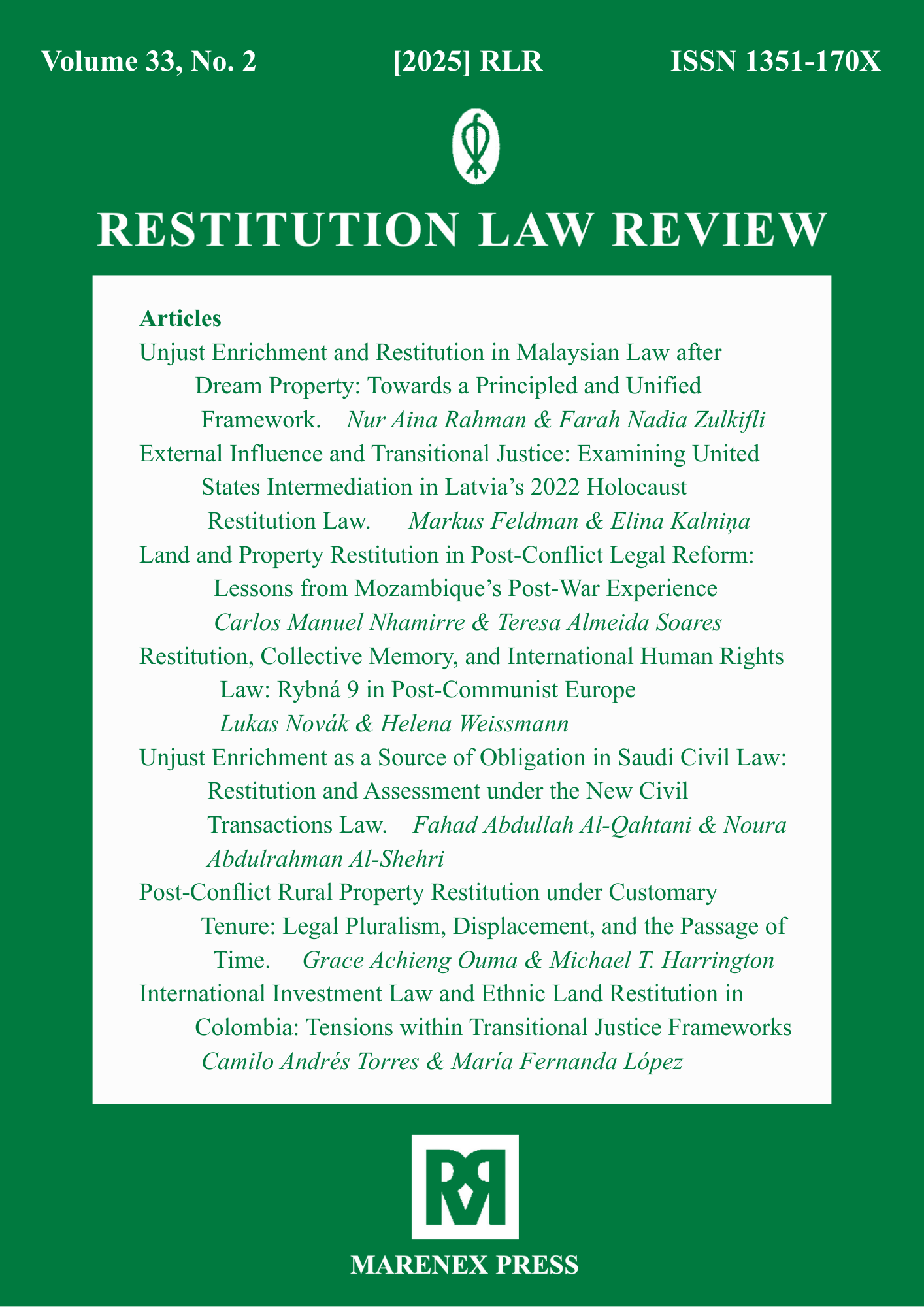
External Influence and Transitional Justice: Examining United States Intermediation in Latvia’s 2022 Holocaust Restitution Law
Keywords:
transitional justice, Holocaust restitution, Latvia, external intermediation, post-communist memory politics, political valuesAbstract
Holocaust restitution legislation has played a significant role in shaping post-war and post-communist political cultures across Europe, often serving as a mechanism through which states articulate shared values, historical responsibility, and collective memory. Existing transitional justice scholarship has largely focused on the internal dynamics of European societies and institutions in the development of Holocaust-related legal frameworks. While this body of work has made important contributions, it has tended to underemphasize the role of external actors in influencing domestic restitution processes and the broader political cultures they shape. This article addresses that gap by examining the role of United States intermediation in the adoption of Latvia’s 2022 Holocaust restitution law. Through a contextual and analytical study of legislative developments, diplomatic engagement, and normative discourse, the article explores how U.S. involvement contributed to framing restitution as part of a broader “community of values” linking Latvia to transatlantic political and moral norms. Rather than displacing domestic agency, U.S. intermediation operated alongside Latvian political objectives, influencing both the content of the law and the symbolic meanings attached to it. The analysis situates Latvia’s restitution law within the broader context of post-communist transitional justice, where Holocaust remembrance and restitution intersect with narratives of national victimhood, sovereignty, and democratic alignment. The article argues that U.S. engagement functioned not merely as external pressure, but as a form of normative mediation that reinforced particular understandings of historical justice, responsibility, and political belonging. By foregrounding the role of external actors, this study broadens existing scholarship on transitional justice and Holocaust restitution. It demonstrates how international intermediation can shape domestic legal outcomes and political culture, while also revealing the complex interactions between global norms and national memory politics in post-communist Europe.
Downloads
Published
Issue
Section
License
Copyright (c) 2025 Restitution Law Review

This work is licensed under a Creative Commons Attribution-NonCommercial 4.0 International License.