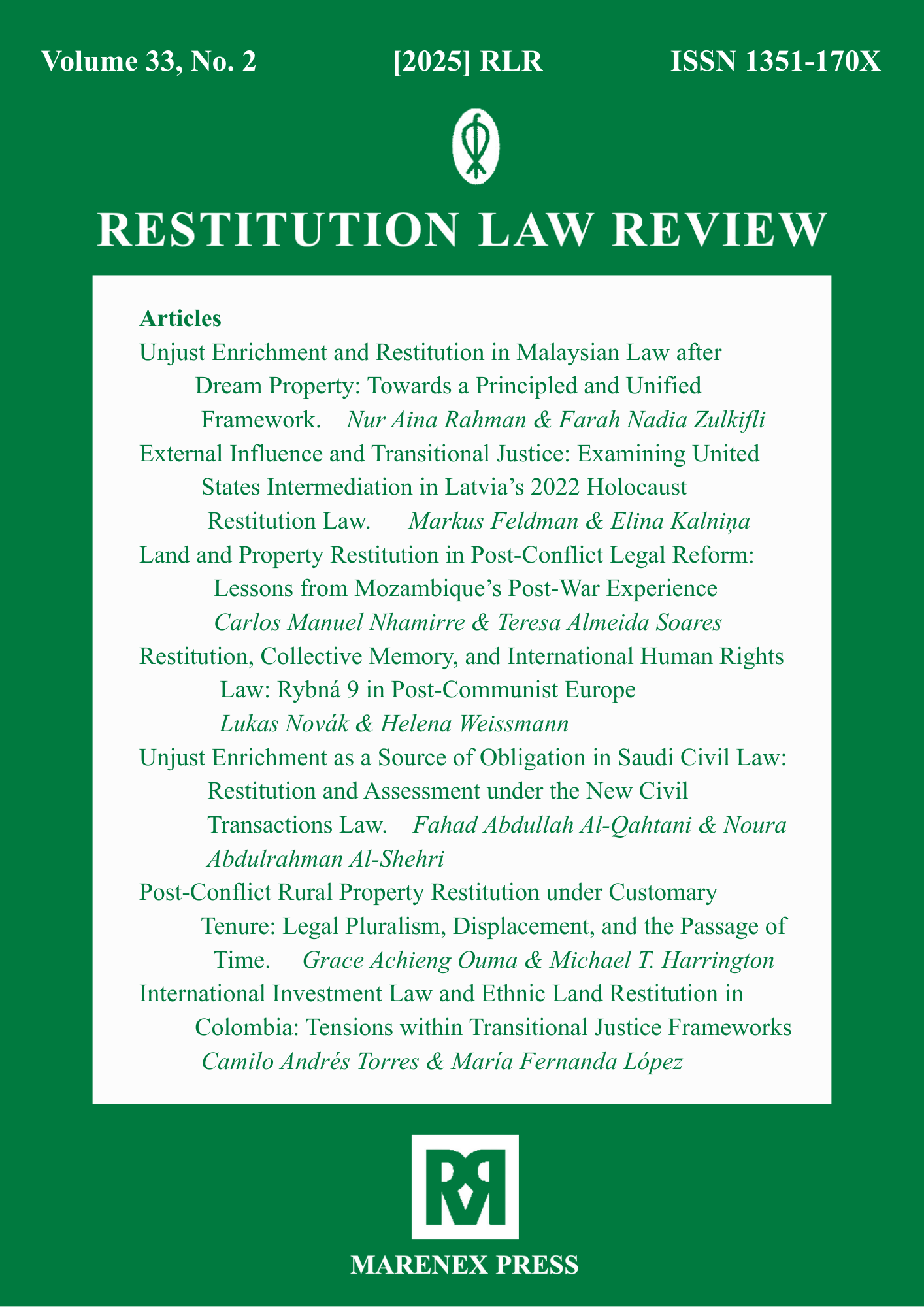
Land and Property Restitution in Post-Conflict Legal Reform: Lessons from Mozambique’s Post-War Experience
Keywords:
post-war restitution, land and property law, post-conflict legal reform, Mozambique, land policy, peacebuildingAbstract
Post-war reconstruction presents distinct legal and institutional challenges, particularly where land and property restitution is central to peacebuilding, social stability, and economic recovery. Armed conflict often produces a fragmented and contested rights environment, marked by displacement, overlapping claims, and weakened state authority. In such contexts, governments face significant constraints in designing and implementing restitution regimes, including limited administrative capacity, scarce financial resources, and deep social divisions. This article examines Mozambique’s experience in developing a land and property restitution framework in the aftermath of prolonged civil war, offering insights into how legal reform can function under severe post-conflict conditions. The article situates Mozambique’s restitution efforts within a complex post-war context characterised by strong and competing restitution claims among highly diverse population groups. These groups differed substantially in literacy levels, access to state institutions, wartime allegiances, recognition of legitimate authority, and reliance on customary or formal tenure systems. The analysis further highlights the legacy of shifting and often unsuccessful land policies that shaped public expectations and legal uncertainty prior to and during the conflict. Compounding these challenges was the limited institutional capacity of the Mozambican state to administer a comprehensive, centrally managed restitution programme. Following an overview of the civil war and the evolution of land policy in Mozambique, the article examines how restitution claims were addressed through legal reform rather than through large-scale adjudication. Particular attention is paid to the land law reforms that sought to create a legal environment in which many restitution disputes could be resolved through decentralised, community-based, and “self-managed” processes. The article argues that this approach reflects a pragmatic adaptation to post-war realities, balancing legal certainty with flexibility and social legitimacy. It concludes by assessing the broader implications of Mozambique’s experience for restitution law in post-conflict societies, emphasizing the importance of context-sensitive legal design in fragile institutional settings.
Downloads
Published
Issue
Section
License
Copyright (c) 2025 Restitution Law Review

This work is licensed under a Creative Commons Attribution-NonCommercial 4.0 International License.