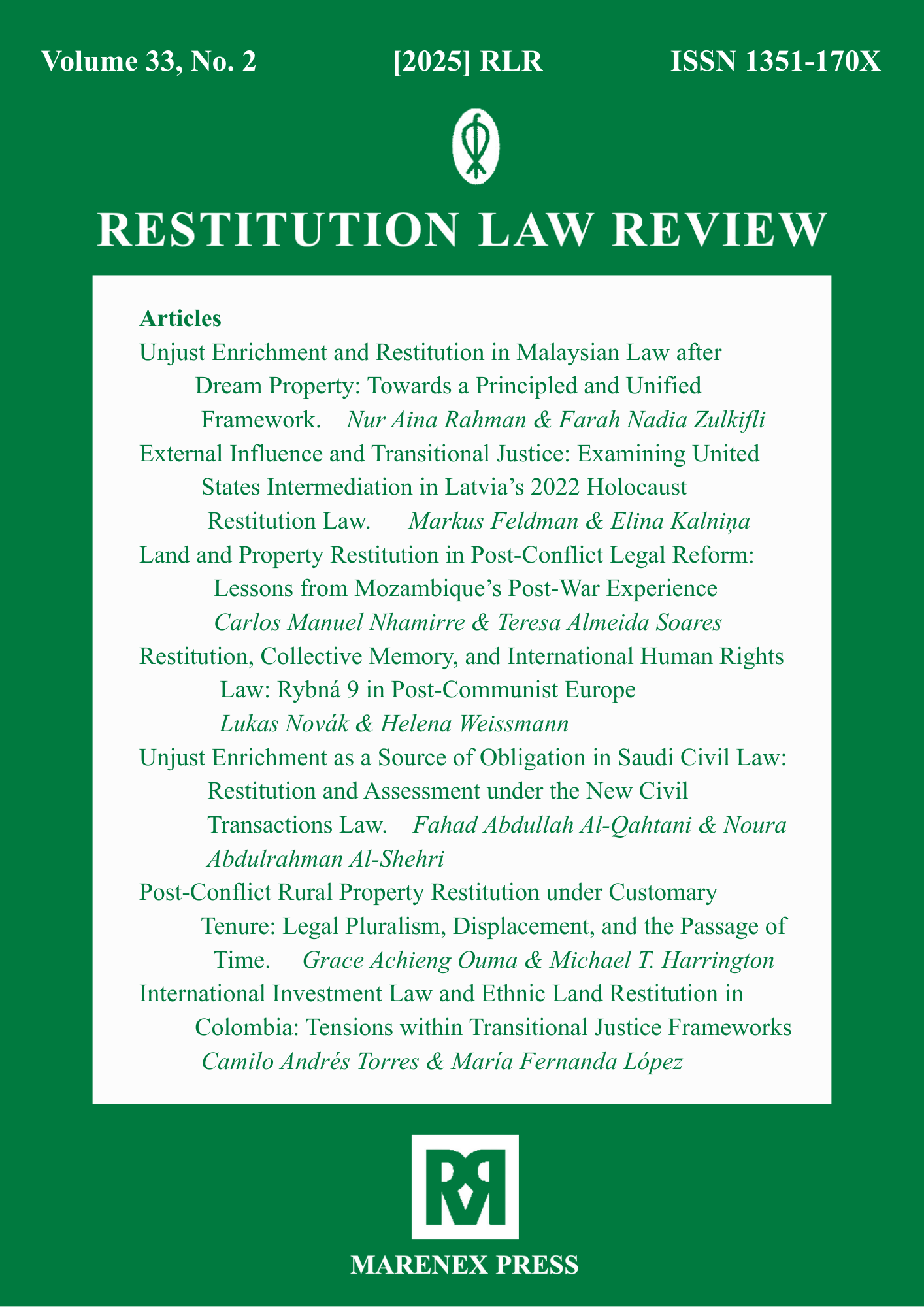
Restitution, Collective Memory, and International Human Rights Law: Rybná 9 in Post-Communist Europe
Keywords:
international human rights law, restitution, collective memory, post-communist Europe, equality, European citizenshipAbstract
The legal history of Rybná 9, Praha 1—a building located in Prague’s historic centre—offers a compelling lens through which to examine the relationship between international human rights law and the politics of collective memory. As international human rights regimes generate new forms of legal rights and obligations, they also participate in shaping how societies remember, interpret, and contest the past. This article explores how international human rights law engages with collective memory in the context of post-communist restitution initiatives in Central and Eastern Europe, where competing historical narratives continue to influence legal outcomes. Focusing on Rybná 9 as the subject of a restitution challenge before the United Nations Human Rights Committee, the article situates this case within a broader set of disputes that have also reached the European Court of Human Rights. Through comparative analysis, it examines how these two international bodies conceptualize equality and historical responsibility. The Human Rights Committee is shown to adopt an approach that accommodates certain historical injustices within an equality framework, allowing aspects of the past to be legally “remembered.” By contrast, the European Court of Human Rights tends to adopt a more modernist orientation, treating equality as a principle that requires distancing from historical contingencies and, in effect, repudiating history as a legal category. This divergence becomes particularly visible when comparing the treatment of collective memories associated with Jewish communities and the Holocaust on the one hand, and those linked to Sudeten Germans displaced after the Second World War on the other. The article argues that international human rights law does not merely adjudicate restitution claims but actively shapes the politics of memory that underpin them. In doing so, it reflects and contributes to broader debates about identity, belonging, and the evolving nature of European citizenship in the post-communist era.
Downloads
Published
Issue
Section
License
Copyright (c) 2025 Restitution Law Review

This work is licensed under a Creative Commons Attribution-NonCommercial 4.0 International License.