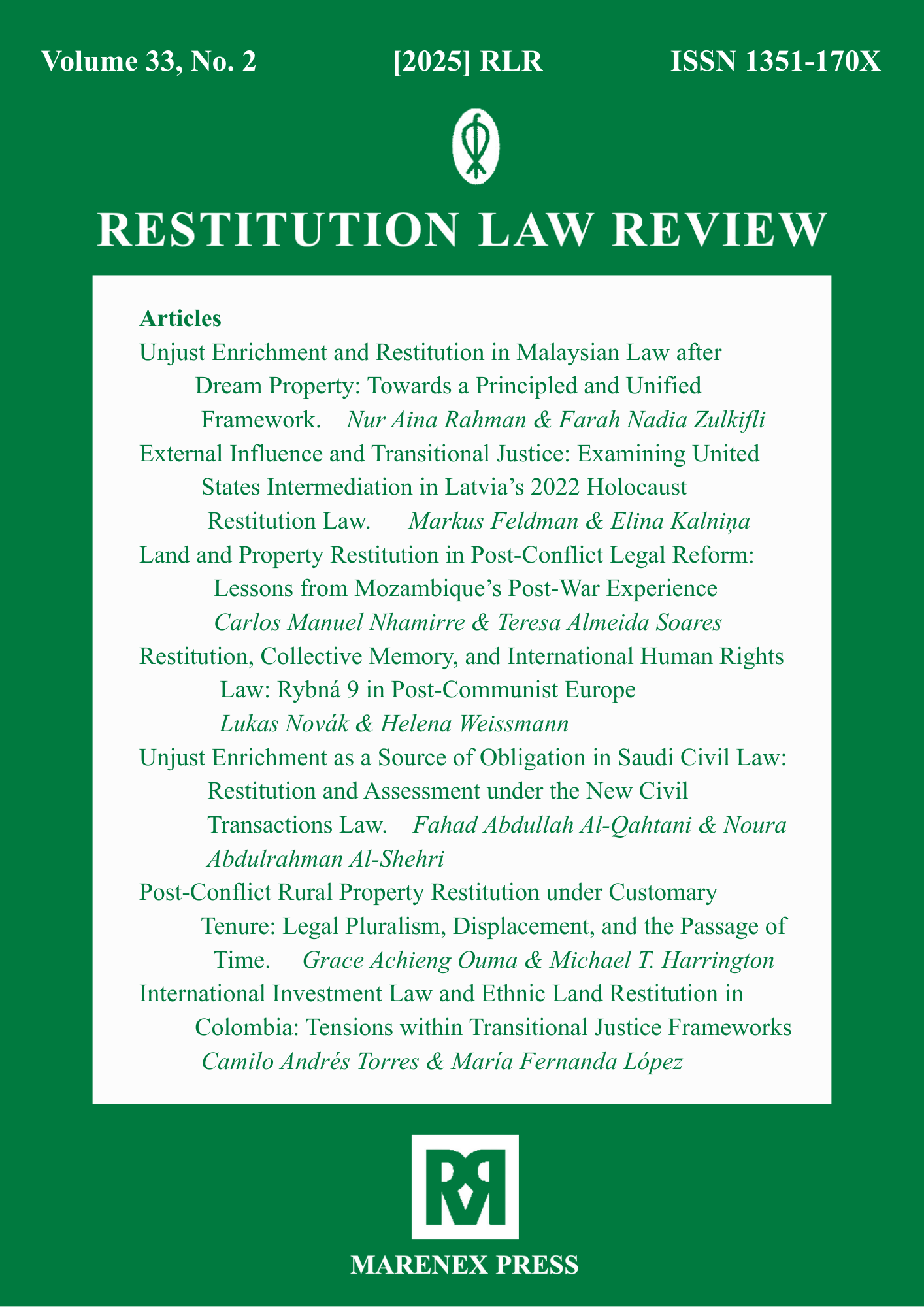
Post-Conflict Rural Property Restitution under Customary Tenure: Legal Pluralism, Displacement, and the Passage of Time
Keywords:
post-conflict restitution, customary land tenure, rural property rights, displacement and return, legal pluralism, transitional justiceAbstract
Large-scale displacement caused by armed conflict presents profound challenges for property restitution, particularly in rural contexts where land is predominantly governed by customary tenure systems. Unlike voluntary migration, violence-induced displacement disrupts both community-based customary norms and formal state legal-administrative mechanisms, creating complex barriers to restitution upon return. These difficulties are exacerbated by prolonged absences, demographic change, and the absence of written documentation characterising customary landholding regimes. This article examines how post-conflict restitution unfolds under customary law after extended displacement, with a focus on the tensions between local tenure practices and international legal norms on property restitution. Drawing on comparative fieldwork conducted in Uganda, Liberia, and Timor-Leste, the article makes three principal contributions. First, it highlights the diversity of return processes following long-term displacement, demonstrating that timing, generational change, and social reintegration significantly affect restitution outcomes. Second, it shows that the nature of claims recognised within customary tenure systems—often dependent on physical presence, social belonging, and endorsement by community leaders—frequently conflicts with international restitution standards that prioritise formal ownership and abstract property rights. In this context, returnees may be reintegrated into communities with relative ease, while displaced persons seeking restitution without physical return face substantial, and often insurmountable, obstacles. Third, the article explores how conflict and displacement themselves reshape customary law. It argues that customary tenure is neither static nor purely traditional, but evolves in response to violence, demographic shifts, and post-conflict governance interventions. These transformations raise important normative and practical questions about the compatibility of international restitution frameworks with local legal orders. The article concludes by emphasizing the need for restitution approaches that are sensitive to legal pluralism, temporal distance, and the social foundations of customary property rights in post-conflict rural settings.
Downloads
Published
Issue
Section
License
Copyright (c) 2025 Restitution Law Review

This work is licensed under a Creative Commons Attribution-NonCommercial 4.0 International License.