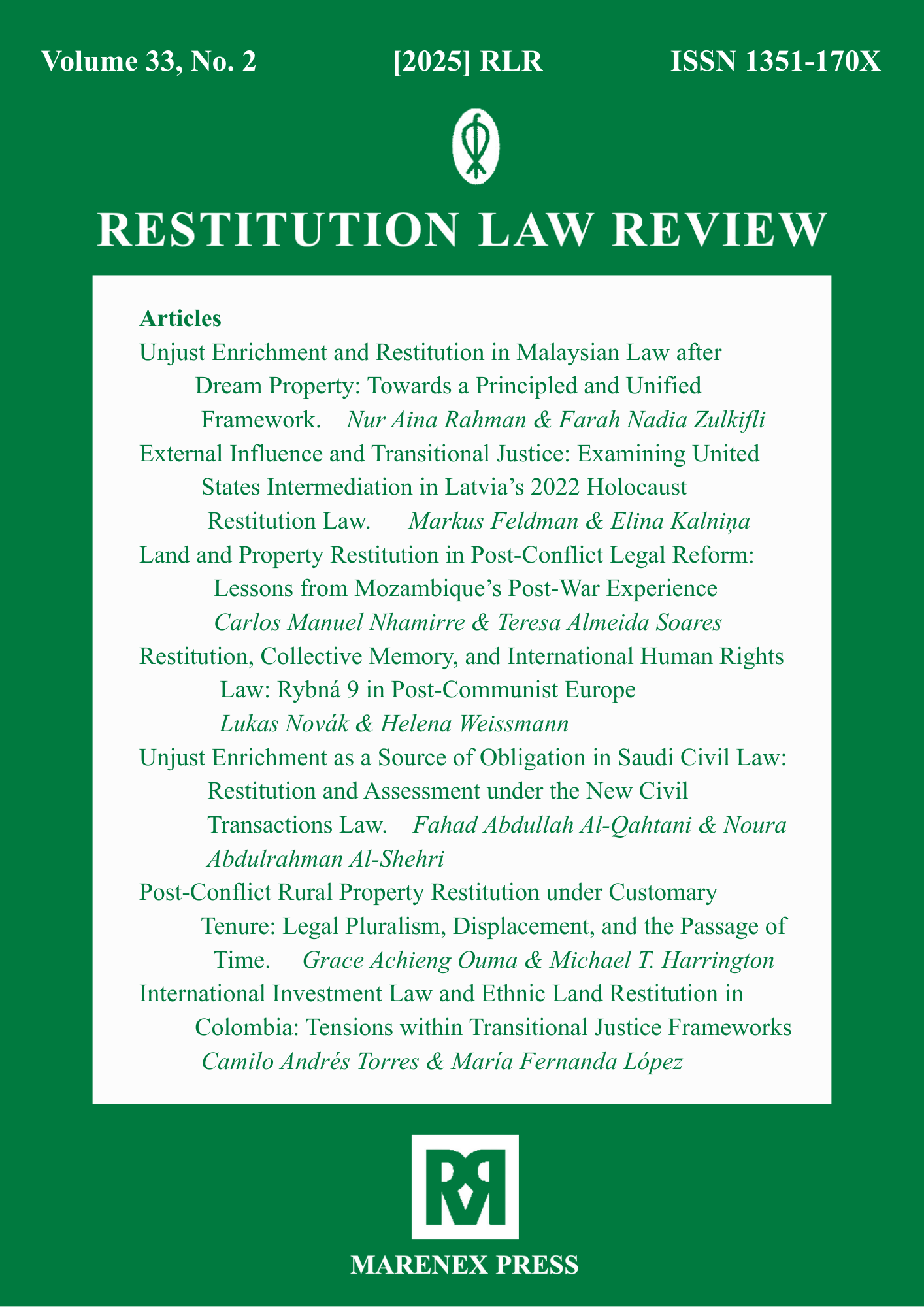
International Investment Law and Ethnic Land Restitution in Colombia: Tensions within Transitional Justice Frameworks
Keywords:
land restitution, international investment law, transitional justice, ethnic communities, Colombia, investment arbitrationAbstract
Colombia’s transitional justice framework incorporates a range of mechanisms designed to address the harms suffered by victims of its prolonged internal armed conflict. Among these mechanisms is a specialised judicial process enabling ethnic communities affected by land dispossession and forced displacement to seek the legal and material restitution of their ancestral lands and territories. While this framework reflects a strong formal commitment to restorative justice, its implementation has increasingly encountered friction arising from competing economic interests, particularly those of foreign-owned mining enterprises operating on contested land. This article examines the interaction between Colombia’s ethnic land restitution programme and the international legal protections afforded to foreign investors under international investment agreements. Through an analysis of restitution cases involving overlapping claims by ethnic communities and mining companies, the article demonstrates how state institutions responsible for implementing restitution have exhibited growing sensitivity to investor interests. This sensitivity is reflected in the cautious use of legal remedies that might impose significant burdens on mining operations, even where such remedies could advance the restitution claims of displaced communities. Focusing on a representative case study, the article provides evidence that this institutional caution has been shaped by concerns over potential international investment arbitration proceedings against the Colombian state. The prospect of costly disputes under investment treaties appears to influence domestic decision-making, subtly reshaping the balance between victim-centred restitution and the protection of foreign investment. The article argues that this dynamic exposes structural tensions within transitional justice processes when they intersect with international economic law. It highlights the risk that restitution programmes, particularly those addressing the rights of vulnerable ethnic groups, may be constrained by external legal regimes that prioritise investor protection. The article concludes by calling for greater coherence between transitional justice objectives and international investment law to ensure that restitution mechanisms fulfil their restorative and distributive aims without undue external constraint.
Downloads
Published
Issue
Section
License
Copyright (c) 2025 Restitution Law Review

This work is licensed under a Creative Commons Attribution-NonCommercial 4.0 International License.